
The Ultimate Dog Match Guide: How to Find the Perfect Breed for Your Lifestyle
Bringing a dog into your life can be one of the best decisions you’ll ever make. But unlike buying furniture or a new phone, choosing a dog is like entering into a long-term relationship. It requires mutual compatibility, understanding, and shared lifestyle goals. This process is often called finding your “Dog Match.” Many new owners…

Bringing a dog into your life can be one of the best decisions you’ll ever make. But unlike buying furniture or a new phone, choosing a dog is like entering into a long-term relationship. It requires mutual compatibility, understanding, and shared lifestyle goals. This process is often called finding your “Dog Match.”
Many new owners make the mistake of choosing a dog based solely on its appearance or popularity (known as the “movie star effect”). This often leads to heartache and frustration: a high-energy Husky destroying a small apartment, for example, or a shy rescue dog becoming terrified of a noisy family.
This comprehensive guide is designed to help you understand the complex world of different dog personalities. We’ll go beyond the superficial and delve deeper into the genetic factors, energy levels, and temperaments that determine the best match between you and your dog. Whether you’re a marathon runner, a work-from-home professional, or a busy parent, there’s sure to be a dog that’s perfect for you.
The Big Three of Dog Matching: Energy, Space, and Time
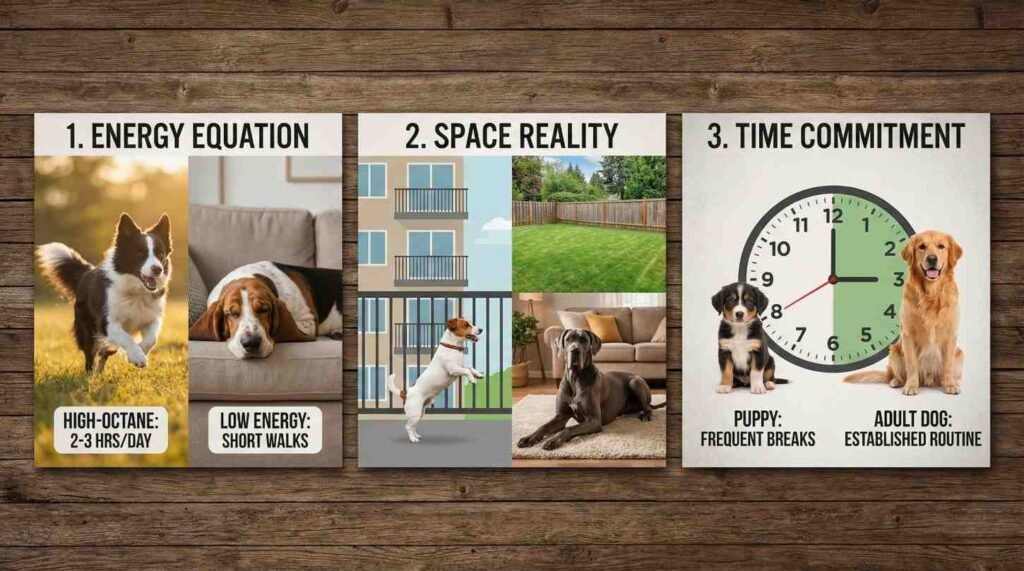
Before you even look at a specific breed, you must audit your own life. The “Big Three” variables are the non-negotiable foundations of a successful dog match.
1. The Energy Equation
This is the biggest reason dogs are “badly chosen” and are returned to shelters. You should choose a dog’s energy level based on your reality, not your desires.
- High-octane : Breeds like Border Collies, Belgian Malinois, and Vizslas are not just pets, they are a lifestyle choice. They require 2 to 3 hours of vigorous physical exercise daily. If you are a marathon runner or a sports enthusiast, these are the perfect pairing for you. But if you work 10-hour days and want to relax on the weekends, these dogs will start destroying the house out of boredom.
- Moderate-energy: Golden Retrievers, Labs, and Schnauzers. These dogs are also happy to go on long hikes and love to sit quietly for movie night. This is the best and most balanced choice for most active families.
- Low energy: Basset Hounds, English Bulldogs and (surprisingly) Greyhounds. These dogs are happy with a few short walks and a nap during the day. They are a great companion for apartment dwellers or less active owners.
2. The Space Reality
- The Apartment Myth: Many people believe that “small dog = apartment dog.” This is not true. A Jack Russell Terrier is small in size but has enough energy to run around bumping into the walls of a small studio apartment. In contrast, a Great Dane is much larger but often sleeps all day like a “rug dog” and is great for small homes, as long as he is walked daily.
- The Yard Requirement: Sniffing hounds (like beagles) and herding breeds generally need a fenced yard. This is not only important for exercise, but also for mental stimulation.
3. The Time Commitment
- Choosing a Puppy : If you work from home or have a family member who is home all the time, getting a puppy is a better option. They need to be taken out for potty breaks every 2 hours.
- Choosing an Adult Dog: If you work from 9am to 5pm, an adult dog (2 years old or older) is often a better choice. Their bladder control is fully developed and their personality is already established, so you know in advance what kind of temperament you are getting.
Decoding the Breeds: Finding Your Category Match
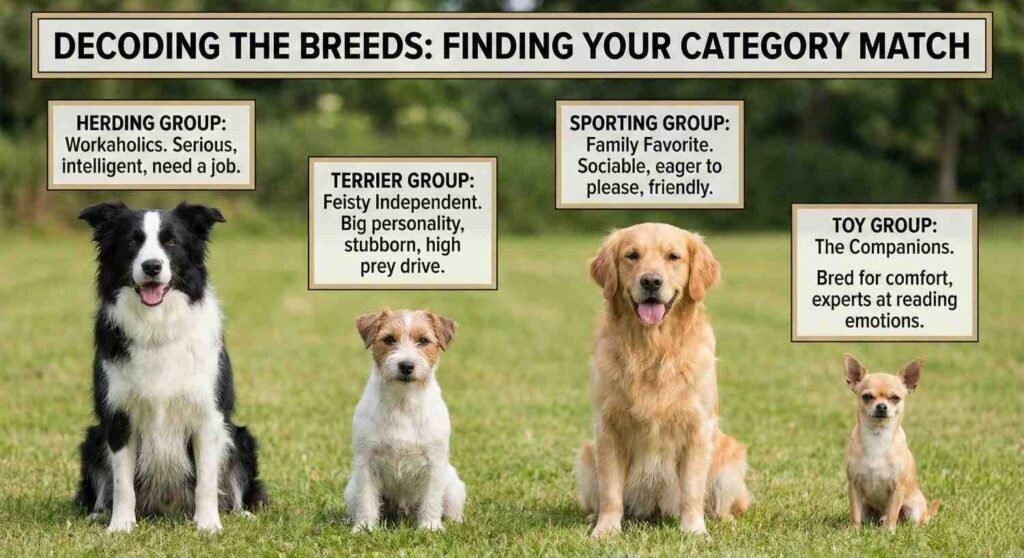
Dogs were bred and developed for specific tasks. Even if you don’t need a dog to herd sheep, those genetic instincts will show up in your drawing room.
The Herding Group (The Workaholics)
- Breeds: Border Collie, Australian Shepherd, Corgi, German Shepherd.
- Profile: These dogs are very serious, intelligent, and quick-witted. They are always looking for some “job” to do.
- Best for you if: You want a dog that hangs on your every word and you enjoy training it.
- Avoid if: You want a dog that can play alone in the backyard. If these dogs are not properly trained, they will try to herd (encircle) your children and may nip at their heels.
The Terrier Group (The Feisty Independent)
- Breeds: Jack Russell, Westie, Bull Terrier, Scottish Terrier.
- Profile: They have a “big dog personality in a small body.” They were bred to hunt rats and other small vermin on their own. They are stubborn, determined, and highly active.
- A good match for you if: You have a sense of humor and are patient. You want a dog that is strong and has a strong personality.
- Avoid if: You have small pets (like hamsters or rabbits), as terriers have a very strong hunting instinct. In addition, these dogs can also bark a lot.
Sporting Group (Family Favorite)
- Breeds: Golden Retriever, Labrador, Cocker Spaniel, Pointer.
- Summary (Profile): These dogs are sociable, eager to please their owner, and generally friendly with strangers and other dogs.
- A good match for you if: You are getting a dog for the first time or your household is busy with children. These dogs are forgiving of mistakes made during training and usually adapt to the situation.
- Avoid if: You need a guard dog or you hate shedding. These dogs shed a lot.
The Toy Group (The Companions)
- Breeds: Chihuahua, Cavalier King Charles, Pomeranian, Shih Tzu.
- The Profile: Bred strictly for companionship. They are experts at reading human emotions and providing comfort.
- Your Match If: You live in a city, travel frequently (they fit in carriers), or live in a condo.
- Avoid If: You have very young, boisterous toddlers who might accidentally hurt a fragile dog, or if you dislike “velcro” dogs that follow you to the bathroom.
The Working/Guardian Group (The Protectors)
- Breeds: Doberman, Rottweiler, Boxer, Great Pyrenees.
- Profile: These dogs are loyal, protective, and physically powerful. They are often aloof or aloof with strangers but are completely devoted to their family.
- A good match for you if: You have experience with dogs and understand the importance of leadership and socialization. You want a dog that you feel safe around.
- Avoid if: You are soft-spoken or can’t handle being strict. These dogs need clear boundaries, otherwise they will establish their rule over the entire household.
The “Doodle” Dilemma: Matching with Hybrids
In the past decade, “Doodles” (poodle crosses such as Golden Doodles, Libra Doodles, Bernese Doodles) have dominated the dog-selection search.
Appeal: They are marketed on the basis that they are hypoallergenic and have the best qualities of two different breeds (e.g., the friendliness of a Golden Retriever and the intelligence of a Poodle).
Reality: A hybrid or mixed-breed dog is genetically like a “toss” (a coin flip). You might find a dog that sheds and is nervous like a Poodle, or a dog that doesn’t shed but has the energy of a Golden Retriever.
Best Pairing: If you choose a “Doodle,” you should be prepared for a lot of cleaning and grooming. Their hair tangles very quickly and they need to be groomed by a professional every 6 to 8 weeks, which is a major budget issue.
Rescue vs. Breeder: Two Paths to a Match
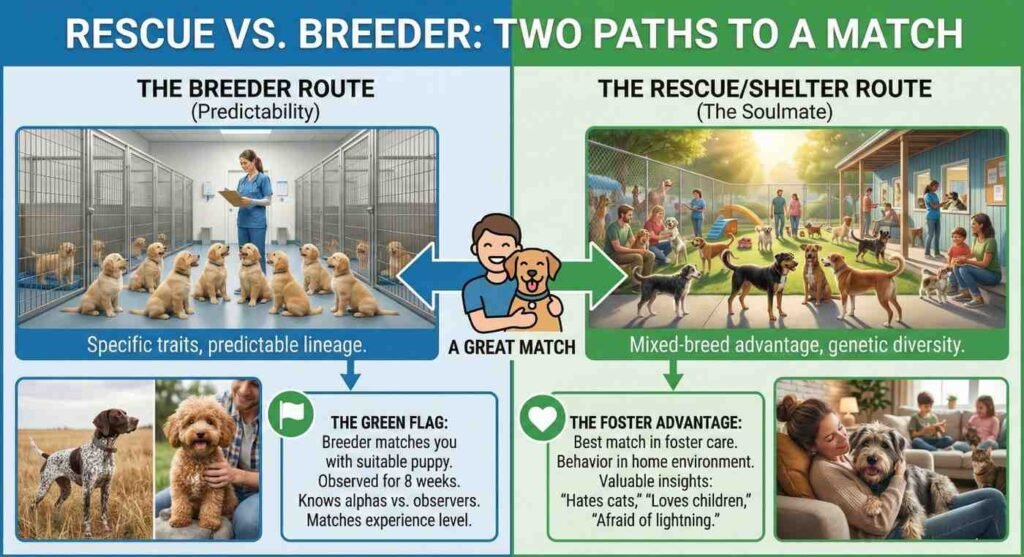
Once you’ve identified the type of dog that fits your life, you have two paths ahead of you. Both paths can lead to a great match, but they require different approaches.
The Breeder Route (Predictability)
If you need specific traits—for example, a dog that is guaranteed to point at birds for hunting, or a dog that is guaranteed to be hypoallergenic due to severe allergies—then choosing a reputable and reputable breeder is the best way to go.
- The Green Flag: A good breeder will match you with a suitable puppy. They won’t just let you get the cutest looking puppy. They observe the entire group of puppies for 8 weeks and know which pups are dominant alphas and which are shy and quiet observers. They will give you the puppy that is most suited to your level of experience.
The Rescue/Shelter Route (The Soulmate)
Adopting dogs is a noble and commendable path. Shelter dogs are often mixed-breed, which can be a genetic advantage (because they have fewer hereditary diseases and are stronger).
- The Foster Advantage: The best way to find the best match for a rescue dog is to look at dogs that have been in “foster care.” A dog will react differently in a noisy shelter cage than in a home environment. A foster care person may tell you: “He hates cats,” “He loves children,” or “He’s afraid of lightning.” This information is invaluable in finding a true and perfect match.
The “Vibe Check”: Assessing Temperament
You’ve done your research and found a potential dog. Now how do you confirm for yourself whether or not this is the perfect match for you? Follow these simple observational tests (but always ask permission first).
- The Approach Test: Kneel on the ground. Does the dog rush towards you and jump on you (excited)? Does he shy away (scared)? Or does he approach cautiously, sniff you, and then wag his tail (balanced)? You should be looking for a dog with a balanced response.
- The Handling Test: Gently touch the dog’s paws or ears. A dog that is suitable for a family with children should be patient when touched and handled, and not immediately try to bite or show aggression.
- The Recovery Test: Drop a bunch of keys on the floor (so that the dog is suddenly startled). A confident dog will jump first, then look at the keys and perhaps sniff them. Conversely, a timid dog will run away and not be able to get out of this fear for several minutes.
Lifestyle Scenarios: Quick Match Guide
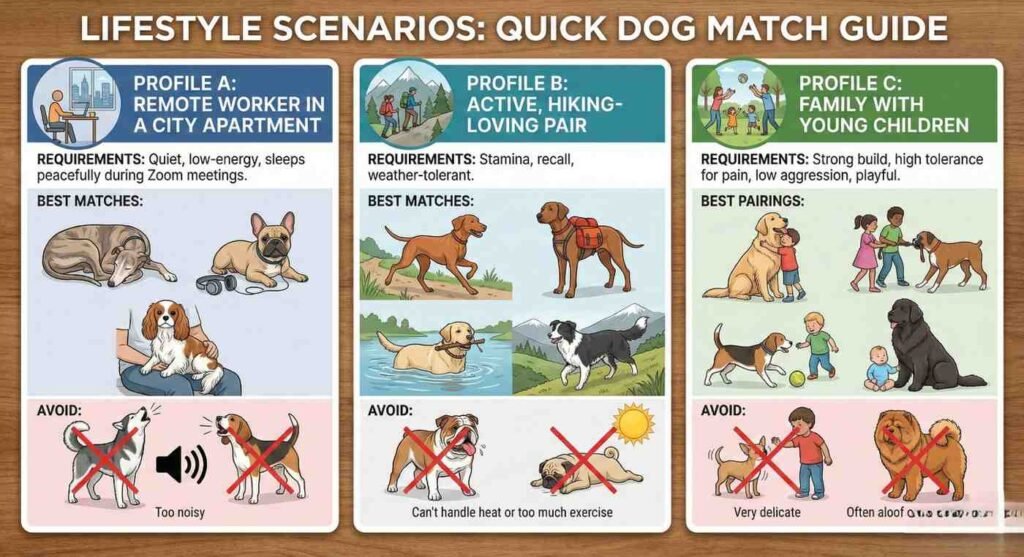
Profile A: Remote Worker in a City Apartment
Requirements: Quiet, low-energy, and a dog that sleeps peacefully during Zoom meetings.
Best Matches: Greyhound, French Bulldog, Cavalier King Charles Spaniel.
Avoid: Siberian Husky, Beagle (too noisy).
Profile B: Active, hiking-loving pair
Requirements: Stamina, recall, and weather-tolerant.
Best Matches: Vizsla, Rhodesian Ridgeback, Labrador Retriever, Border Collie Mix.
Avoid: English Bulldog, Pug — They can’t handle heat or too much exercise.
Profile C: Family with young children
Requirements: Strong build, high tolerance for pain, low aggression, and playful.
Best Pairings: Golden Retriever, Boxer, Beagle, Newfoundland (if you have the space).
Avoid: Chihuahua — They are very delicate; Chow Chow — They are often aloof or overprotective.