
Black Falcon – The Black Predator of the Skies
The Mysterious Beauty of the Black Falcon: Australia’s Phantom of the Outback Whenever we think of the world’s most famous birds of prey, our attention immediately goes to the amazing speed of the peregrine falcon or the majestic flight of the golden eagle, and the name of the black falcon is often forgotten. But the…
The Mysterious Beauty of the Black Falcon: Australia’s Phantom of the Outback
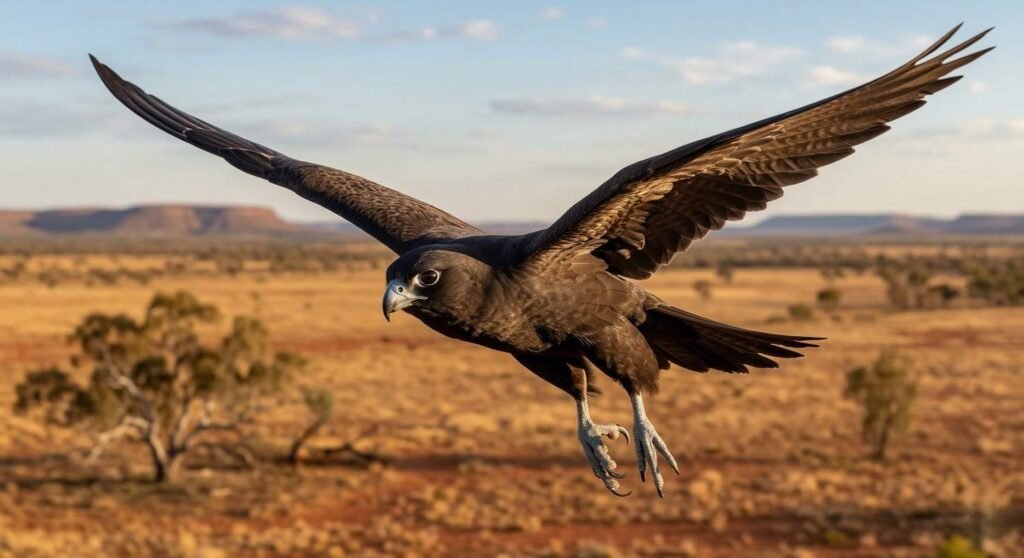
Whenever we think of the world’s most famous birds of prey, our attention immediately goes to the amazing speed of the peregrine falcon or the majestic flight of the golden eagle, and the name of the black falcon is often forgotten. But the truth is that this bird (Falco subniger) flying silently over the difficult, sun-baked plains of Australia is truly nothing short of a marvel.
Known for its deep, shadowy black wings and its extremely aggressive hunting style, this bird rules the skies. It makes the most of its incredible intelligence and tireless power for hunting. You could call it a living symbol of mystery and never-give-up spirit, which has perfectly adapted itself to live in the world’s most difficult and harsh environments.
Scientific Classification and Evolutionary Roots
To truly understand the Black Falcon, we must first look at its place in the avian family tree and how it evolved to conquer the Australian continent.
- Scientific Name: Falco subniger
- Family: Falconidae
- Order: Falconiformes
- Common Name: Black Falcon
- Conservation Status: Least Concern (IUCN Red List), though regional declines are noted.
- Distribution: Endemic to mainland Australia.
The scientific name of this bird is ‘subniger’, which simply means “almost black”. And to be honest, this name fits it perfectly! When this bird flies through the sky or sits peacefully in the shade, it looks like a dark black shadow. But, as soon as the direct and strong sun shines on it, the story turns out to be something else.
In the scorching Australian sun, the color of its wings is not pure black, but a wonderful dark chocolate and grayish brown begins to reflect in them. The edges of its wings are slightly lighter in color, which helps it to fly very fast while tearing through the air.
Another special thing is that in some other birds, the color suddenly turns black due to a genetic mutation, which is considered a defect. But this dark color of the black falcon is not a disease or a defect. This mysterious black color is a gift from nature, which has been its true identity and its permanent natural clothing for centuries.
Body Structure and Characteristics: Best Build for Hunting
The Black Falcon boasts a larger, more robust, yet incredibly streamlined frame compared to many of its falcon cousins. This specific anatomy provides the perfect alchemy of speed, raw strength, and mid-air balance.
Dimensions and Sexual Dimorphism
- Length: 55 to 65 centimeters
- Wingspan: 110 to 130 centimeters
- Weight: 600 to 900 grams
Like most birds of prey, the Black Falcon exhibits sexual dimorphism, meaning the females are noticeably larger and heavier than the males. This size difference allows a mated pair to hunt a wider variety of prey sizes, reducing competition between them.
Distinguishing Features for Identification
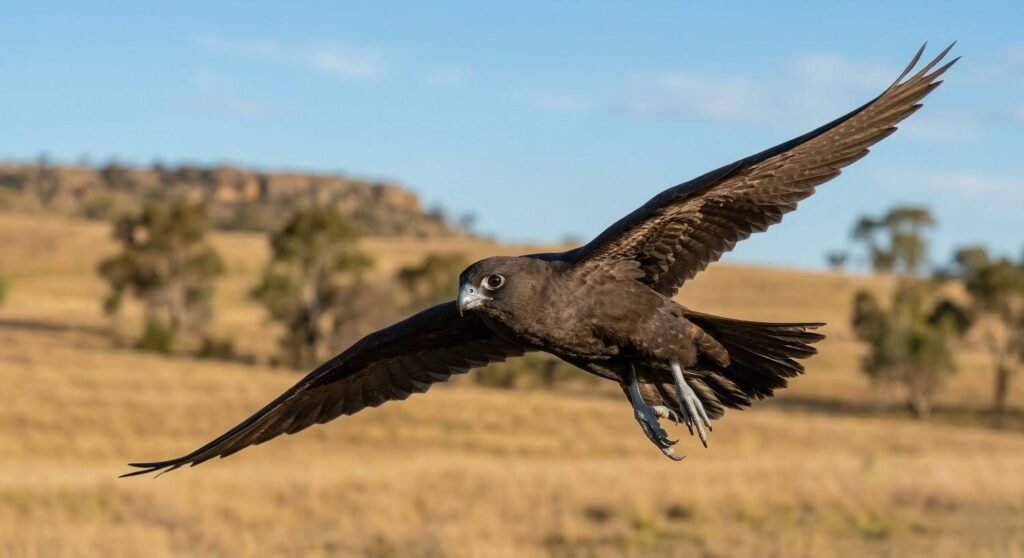
(People often mistake it for a black eagle). But, if you look closely at its body structure, you will see some very special and amazing things:
- Aerodynamic Profile: Its wings are long and pointed at the front. This special structure helps it to fly continuously, very fast and straight in open and wide fields with strong winds.
- Coloration: Its wings are completely dark brown or black. Unlike other falcons, it does not have any stripes or double colors on its belly or chest, but is a single dark color from head to toe.
- Facial Features: Its beak is blue-gray, its eyes are dark brown with a light colored ring around the eyes. An interesting thing is that it does not have a teardrop mark or a deep mustache mark on its face like the Peregrine Falcon.
- Tail Structure: Its tail is slightly longer and slightly forked (V-shaped). This tail works just like a ship’s rudder, which helps it make very spectacular and sudden turns even at high speed.
- Talons and Beak: Its powerful gray-colored legs have razor-sharp talons. Also, its curved, dagger-like strong beak has been designed by nature in such a way that it can break the neck of its prey in the blink of an eye.
A special thing (Note): Black falcon chicks are initially slightly lighter in color, and have light gray stripes on their chest and belly. But as they grow older and younger, these stripes naturally darken to a full and stunning black color.
Habitat, Distribution, and Nomadic Lifestyle
The Black Falcon is a proud resident of the Australian mainland, but it is a highly selective one. It deliberately avoids dense, humid coastal rainforests and heavy woodlands, preferring environments that complement its specific style of contour-hunting.
Preferred Ecosystems
- Open native grasslands and sweeping savannahs
- Expansive agricultural lands, pastures, and freshly plowed fields
- Desert fringes and arid scrublands
- Inland riverbanks, ephemeral wetlands, and wide valleys
The Nomadic Drifter
Unlike some birds of prey that stay in one place all year round, our black falcon is not like that at all. It is a true nomad (always on the move).
Its movements and whereabouts are determined by Australia’s harsh and changing weather. It actually follows the rains, because where it rains, its prey (small animals and birds) increases rapidly.
When severe droughts hit the Australian outback, these falcons migrate to coastal areas or lush farmlands, where they can find water and food easily and in abundance. They are most commonly seen flying over New South Wales, Queensland, Victoria and the interior of South Australia.
Behavior, Flight Mechanics, and Hunting Strategy
The Black Falcon is generally a solitary and fiercely independent bird. While occasionally spotted in pairs during the breeding season or when a massive abundance of prey (like a locust swarm) is available, it is an introverted phantom of the plains.
The Low-Flying Phantom
The flight style of the Black Falcon is its most defining characteristic. While the Peregrine Falcon relies on dizzying, high-altitude dives to strike prey from above, the Black Falcon utilizes a completely different, yet equally deadly, strategy.
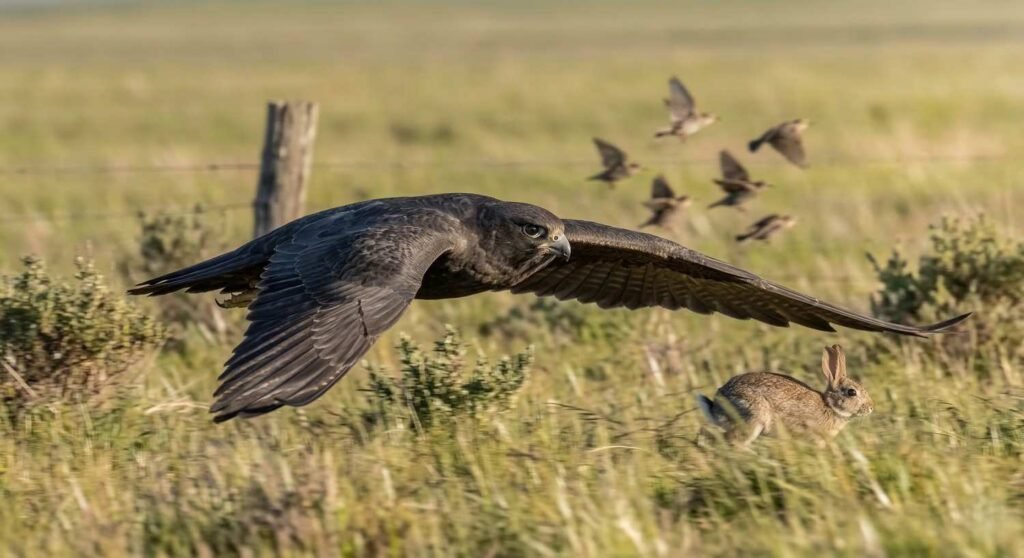
It is an opportunistic, contour-flying hunter. It relies on a smooth, steady, and blindingly fast flight path parallel to the ground—often just a few meters above the grass. By flying so low, it uses the terrain, bushes, and fence lines to mask its approach, taking its prey by complete surprise.
Diet and Aerial Tactics
As a pure carnivore, the Black Falcon requires a constant supply of meat (protein) to sustain its highly mobile and energetic lifestyle.
Its diet and hunting methods are as follows:
- Bird hunting: It mostly targets birds flying in flocks, including Australian parrots (such as galahs and cockatoos), pigeons, mynas and quail.
- Ground hunting: Small rabbits, wild mice, small reptiles (such as lizards) and large insects are also a large part of its daily diet.
- Unique hunting methods: It ambushes its prey on the ground, and chases it in the air until it is exhausted. Sometimes they even hunt together in pairs (male and female) with perfect planning—one falcon scares the prey out of its hiding place, and the other immediately pounces on it.
- Kleptoparasitism: This highly intelligent bird has no shame in stealing the hard work of others! Black falcons often boldly harass other birds of prey (such as brown falcons, black eagles, and even many times their size, the falcons). They dive at them repeatedly until they are tired and forced to throw down their fresh prey.
Breeding and the Harsh Life Cycle
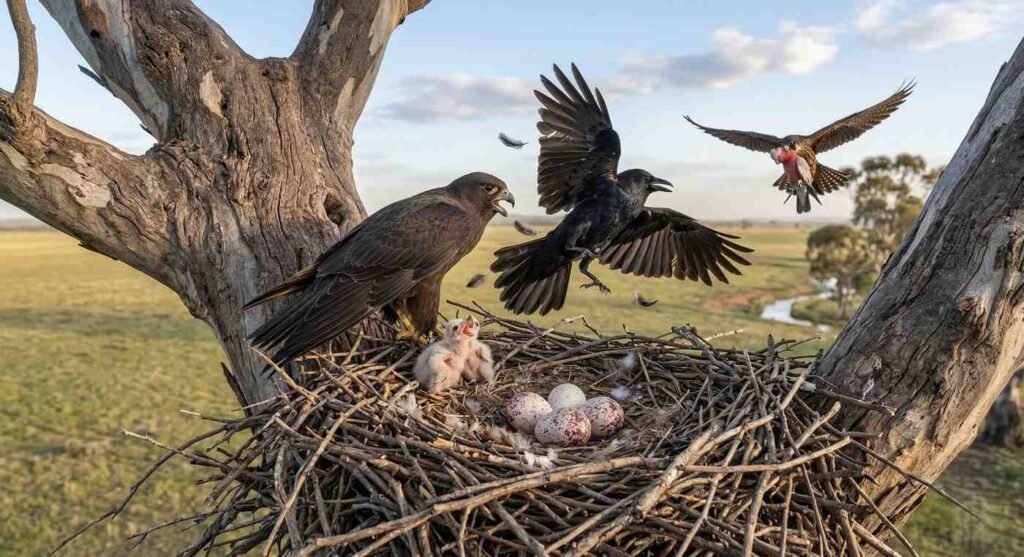
The survival of the Black Falcon depends on successful breeding seasons, which are heavily tied to environmental conditions. Breeding typically spans the Australian winter and spring, occurring from July to December.
The Nesting Takeover
In true falcon fashion, the Black Falcon does not build its own nest. Instead, it forcefully evicts other large birds—such as corvids (crows and ravens) or other raptors—taking over their pre-built stick nests. These hijacked homes are usually located high in the forks of towering river red gums or precariously on remote cliff faces.
Incubation and Fledging
- Clutch Size: A standard clutch consists of 2 to 4 eggs.
- Appearance: The eggs are a pale, chalky white, heavily speckled with reddish-brown and purplish spots.
- Incubation: The female handles the majority of the 30 to 35-day incubation period, while the male becomes the sole provider of food.
Once the chicks hatch, both parents are fiercely devoted. The male hunts relentlessly, passing food to the female, who carefully tears it into manageable pieces for the downy chicks. The young falcons fledge (take their first flight) at around 6 to 7 weeks old. However, the outback is unforgiving, and the juveniles will remain dependent on their parents for several months, loudly begging for food while slowly mastering their own high-speed hunting skills.
The Black Falcon vs. The Peregrine Falcon
To appreciate the Black Falcon, it helps to compare it directly to the world’s most famous raptor. While both are apex predators, their evolutionary paths have equipped them with entirely different toolkits.
| Characteristic | Black Falcon (Falco subniger) | Peregrine Falcon (Falco peregrinus) |
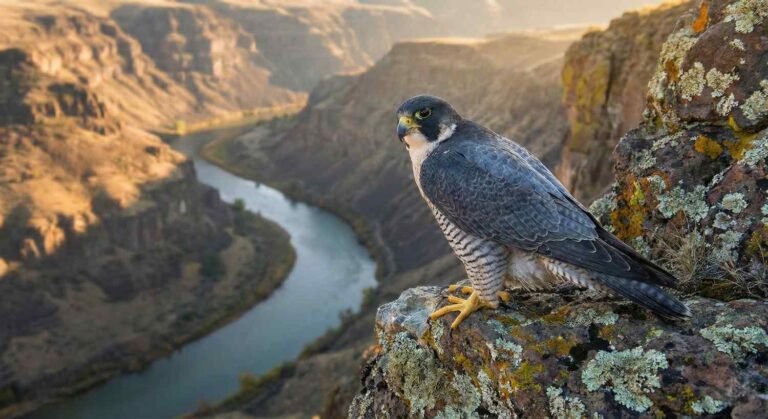
| Plumage | Sooty dark brown/black overall | Bluish-gray back, stark white/barred underparts |
| Hunting Style | Fast, low-to-the-ground pursuit, contour flying | Lightning-fast vertical stoops from high altitudes |
| Global Range | Endemic exclusively to Australia | Cosmopolitan (found worldwide on every continent except Antarctica) |
| Top Speed | Extremely fast in sustained, level horizontal flight | The fastest animal on Earth in a vertical dive (up to 390 km/h) |
| Temperament | Calm, elusive, nomadic, territorial | Aggressive, highly adaptable to urban environments |
Ecological Role, Symbolism, and Conservation
The Balance of Nature
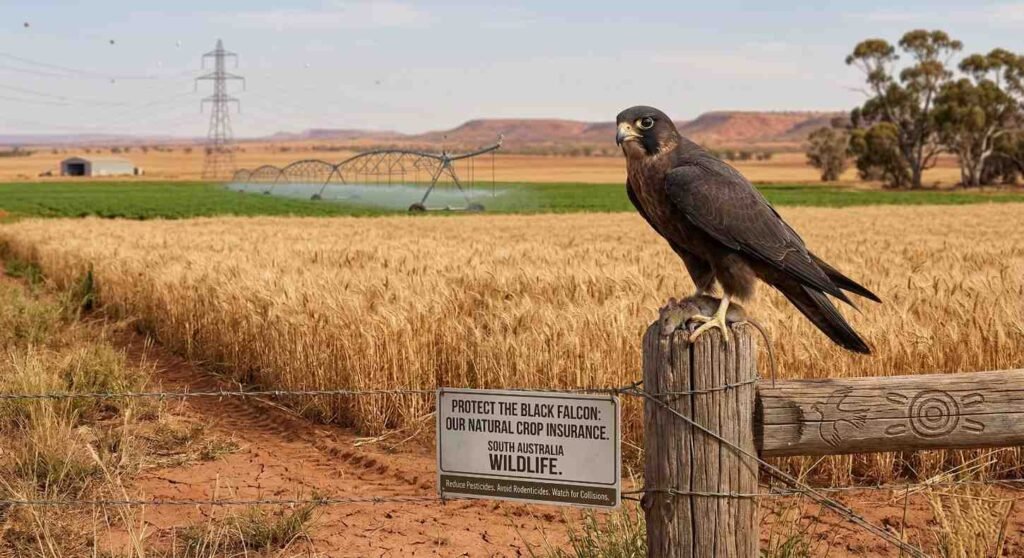
As a large and important predator, the black falcon plays a vital role in maintaining the natural balance of Australia’s desert environment. It controls the rapidly growing populations of rats, rabbits and flocking birds, which can damage crops and prevent overgrazing. Farmers benefit greatly from the presence of these natural predators (pest controllers), as they act as an excellent and free “insurance” from nature to protect their crops.
Symbolism and Cultural Significance
For centuries, birds of prey have captured the attention and thoughts of humans. In the cultures and folklore of the ancient inhabitants of Australia (Aboriginal), these birds of prey are highly respected and are often considered to be messengers of spirits (spiritual messengers). The black falcon—with its silent, shadowy flight, its habit of appearing suddenly, and its sharp eyes—is universally regarded as a powerful symbol of mystery, spiritual power, and protection.
Conservation Threats
Although the black falcon is listed as a bird of “least concern” by the International Union for Conservation of Nature (IUCN), the situation in some areas is worrying. In particular, in South Australia, its population is experiencing significant declines due to the following reasons:
- Habitat destruction: The rapid clearing of native forests and trees for agriculture is destroying the old, hollow trees in which these birds build their nests.
- Secondary poisoning: The widespread use of rodenticides in agriculture. When a falcon eats a poisoned rat, the poison enters its body and causes the falcon to die.
- Collision with wires and fences: Due to their hunting style of flying very close to the ground, they are at high risk of dying from collisions with barbed wire (fences) and high-voltage power lines in their fields.
Australian wildlife organizations are actively working to secure the Black Falcon’s future by protecting vital old-growth nesting trees and educating agricultural communities on the financial benefits of raptor-driven pest control to reduce chemical pesticide use.

One Comment