The California Scrub-Jay: A Complete Guide to the West Coast’s Most Intelligent Bird
This is the California Scrub-Jay (Aphelocoma californica), a bird with a unique personality, intelligence, and a bit of “attitude” (nakhra/tevar). Although locals often call it simply “Blue Jay”—though it’s quite different from its eastern cousin—the California Scrub-Jay is a prominent feature of the western United States. Although these birds are common in backyards and hiking…
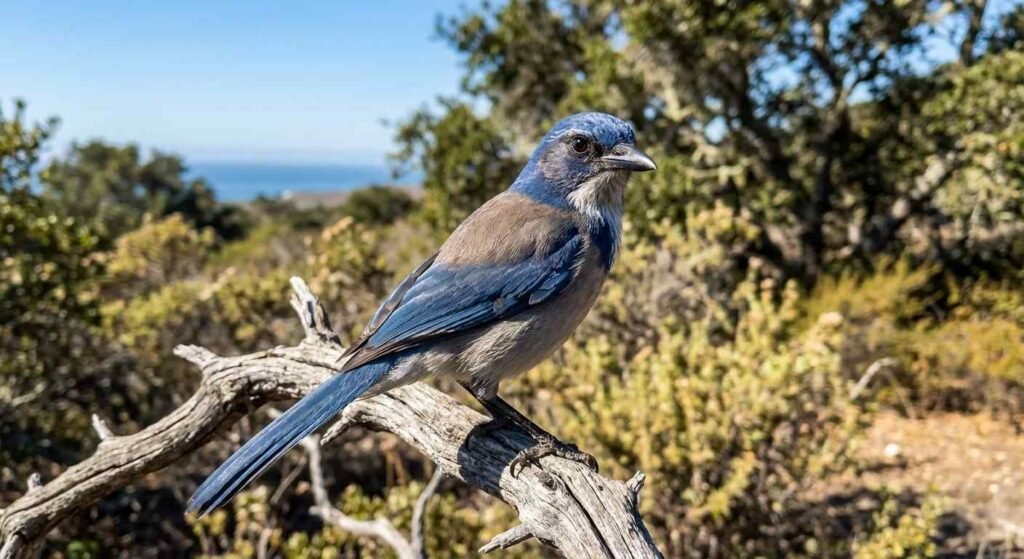
This is the California Scrub-Jay (Aphelocoma californica), a bird with a unique personality, intelligence, and a bit of “attitude” (nakhra/tevar). Although locals often call it simply “Blue Jay”—though it’s quite different from its eastern cousin—the California Scrub-Jay is a prominent feature of the western United States.
Although these birds are common in backyards and hiking trails, they are anything but “ordinary.” They have brains that rival those of chimpanzees; they grow entire forests because of their forgetfulness, and they perform complex social rituals of mourning for their dead mates.
For birdwatchers, nature enthusiasts, and homeowners who want to understand the wildlife in their backyard, the California Scrub-Jay is a fascinating subject.
In this detailed guide, we’ll explore every aspect of the life of the California scrub-jay. From recent changes to their scientific taxonomy to their amazing memory, feeding habits, and tips for attracting (or handling) them to your yard—this is the best resource for understanding one of the smartest birds on the planet.
Taxonomy: The Great Split of 2016
A turning point in history: A new bird identity
To truly understand this bird, we have to turn the pages of the past a little. If you pick up a bird guide or book written before 2016, you won’t find a bird named “California Scrub-Jay.” Instead, you’ll see the name “Western Scrub-Jay.”
For decades, scientists lumped all of these bluebirds of the West into one group. But birders and enthusiasts have long suspected that the birds that live on the hazy, humid shores of the Pacific Coast are quite different from the birds that live in the dry, desert regions of Nevada, Utah, and Texas. The shorebirds are darker, brighter, and have louder voices.
Finally, in 2016, the American Ornithological Union officially recognized this distinction and split the Western Scrub Jay into two separate species:
- California Scrub-Jay: This is now officially recognized as a separate bird, found mostly in California, Oregon, Washington, and Baja California.
- Woodhouse’s Scrub-Jay: This is found in the interior arid regions and the southwestern states.
This split was a huge event in the bird world. This research proved that the California Scrub-Jay is not an ordinary bird, but a special and unique specialist of the Pacific Oak Woodlands, which is completely different from its other desert relatives in its habits and genetic characteristics.
Identification: How to Spot a California Scrub-Jay
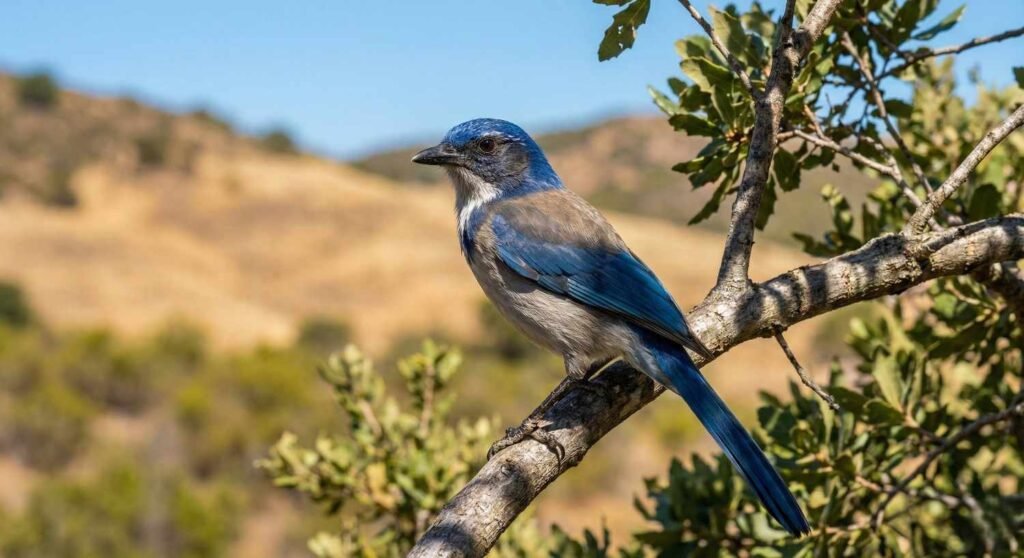
The California Scrub-Jay is relatively easy to identify, but it is often confused (or misidentified) with two other bluebirds found in the West: the Steller’s Jay and the Mountain Bluebird. Below is how you can confidently identify and tell the difference between the California Scrub-Jay.
Physical Description
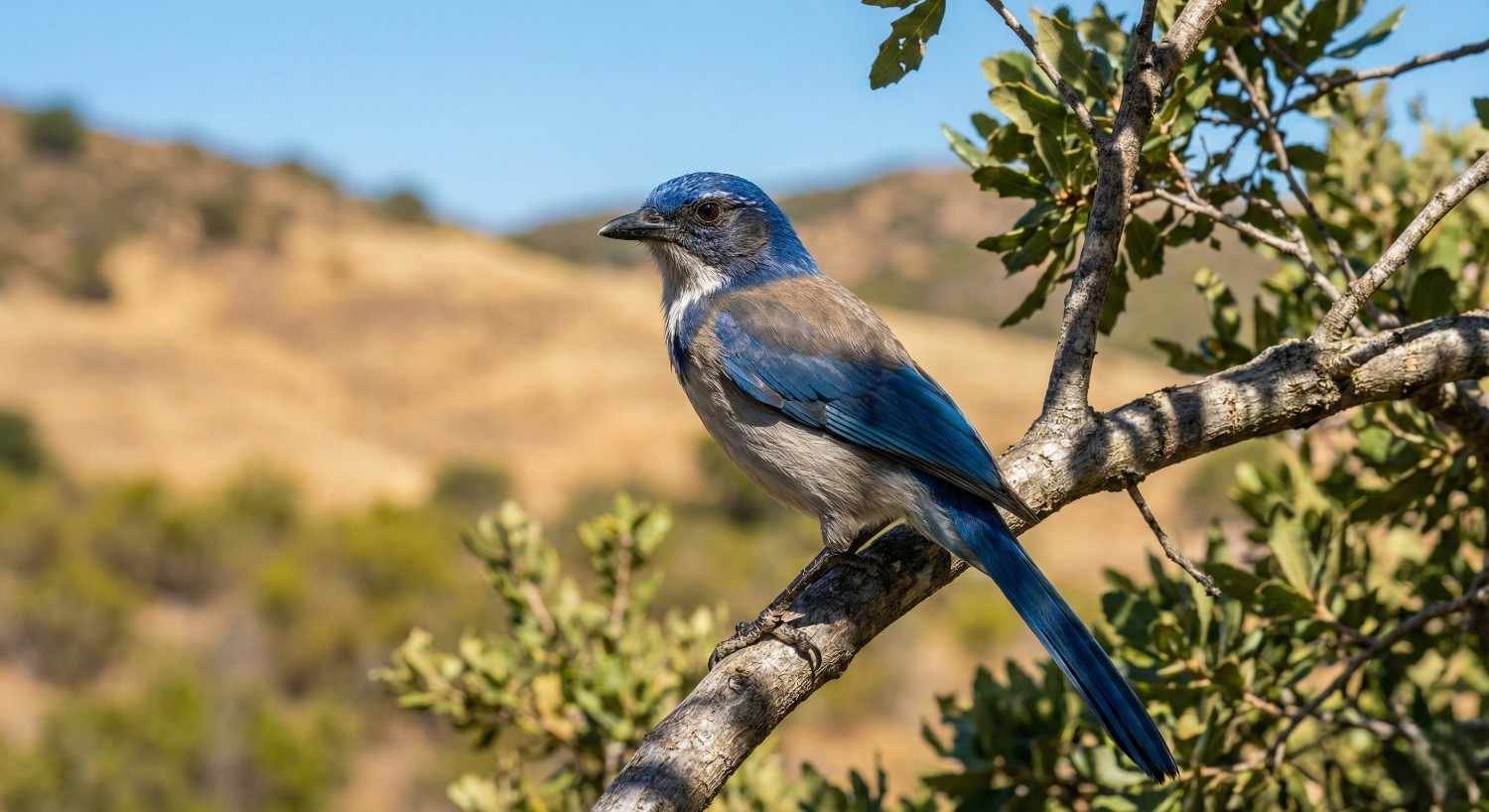
The California Scrub Jay is a medium-sized bird, about 11 to 12 inches long and with a wingspan of about 15 inches. It is larger than a common sparrow but smaller than a crow.
- The Head: Its most striking feature is its head. Its head is smooth and rounded, with a beautiful deep sky-blue color on the crown and back of the neck.
- The Face: Look for a dark charcoal-gray patch on its cheeks. Just above this patch is a line of light white eyebrows that give the bird a sharp, fierce, or very focused appearance.
- The Body: The bird’s back is a distinctly brownish-gray, often likened to a horse’s “saddle.” This brown color of the back stands out in stark contrast to its blue wings and tail. Its throat is white, with a blue “necklace” or band that does not completely connect to the middle of the chest. Its lower abdomen is a light grayish-white.
- The Bill: Their bill is strong, black, and slightly hooked at the front. This bill is like a “multi-purpose tool,” specially designed for catching insects, cracking hard acorns, and even picking up nesting materials.
The Einstein of the Backyard: Intelligence and Cognition
The Corvidae family, which includes jays, crows, ravens, and magpies, is generally considered the most intelligent group of birds. Among them, the California scrub jay holds a unique and prominent position due to its intelligence. Although their brain-to-body ratio is impressive, it is actually their special cognitive skills that have amazed researchers and scientists.
Episodic Memory
For many years, scientists believed that only humans had ‘episodic memory’. This is the ability to mentally travel back in time and remember ‘what happened, where and when’ about a specific event. Previously, it was thought that most animals only had ‘semantic memory’ (knowing facts) or ‘procedural memory’ (knowing how to do something).
But groundbreaking research on Western Scrub Geese (their parent species) led by Professor Nicola Clayton has changed this view forever. In laboratory experiments, the birds were given two types of food to hide:
- Wax worms: which are very tasty but rot quickly.
- Peanuts: which are less tasty but do not spoil for long.
The results of the experiment were surprising:
- If the birds If the birds were given the opportunity to retrieve the food shortly after hiding it, they would go for the waxworms (because they were fresh and tasty).
- But if more time passed, the birds would ignore the waxworms (knowing that they would have rotted by now) and go straight for the peanuts.
Future Planning
These birds also have the ability to plan for the future. During experiments, when these birds were placed in two different compartments (or rooms)—one where breakfast was available in the morning and the other where breakfast was not available—the birds learned to cache food the night before in the ‘no breakfast room’, so that they could plan for their upcoming hunger in advance. Acting on a future need rather than a present desire is a clear sign of high intelligence.
Diet and Foraging Habits
The California scrub jay is an omnivore, meaning it eats both meat and vegetables, and has a voracious appetite. Its diet changes dramatically with the changing seasons, allowing it to utilize all the resources and food that are available at the time.
Spring and Summer Diet
“When acorns are scarce, jays turn to protein for their diet.
- Insects: They hunt beetles, caterpillars, grasshoppers, and ants.
- Small Vertebrates: They are very skilled hunters and will catch lizards, small frogs, and even mice.
- Nest Robbing: This is the behavior that has given them their notoriety. Scrub jays raid the nests of small birds and eat their eggs and chicks. Although this can be painful to watch, it is a natural control on bird populations and an important part of the balance of our ecosystem.
Attracting California Scrub-Jays to Your Yard
For many bird enthusiasts, the California Scrub Jay is a favorite and welcome guest because of its beauty and interesting antics. However, it can often be a ‘bully’ (i.e., it scares away other birds) at feeders. Here’s how you can responsibly attract them.
The Best Foods
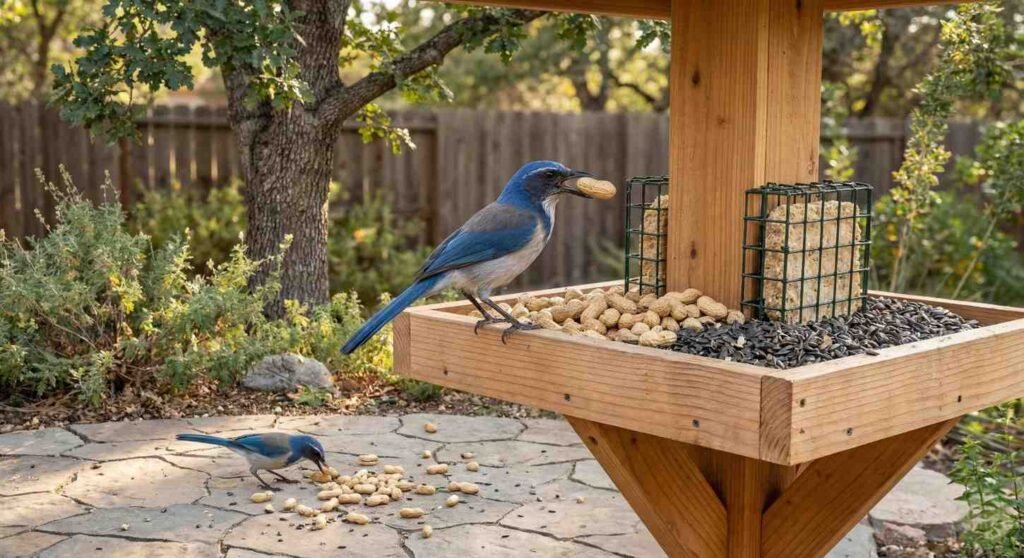
- Shelled Peanuts: This is the perfect treat for Scrub Jays. The shell acts as a sort of puzzle for them, and its size is perfect for hiding or caching. If you place a solid peanut, these birds will get there in minutes.
- Sunflower Seeds: They love black oil sunflower seeds. They will usually dig around the tray with their beaks to find the heaviest and most nutritious seeds.
- Suet: In winter, they will eat suet blocks with great interest because they are high in fat and energy.”
Feeder Types
Jays are large birds, so they cannot balance on small tube feeders designed for finches. Here are some ways to make it easier for them:
- Platform/Tray Feeders: These feeders provide them with a flat, sturdy surface to sit on.
- Ground Feeding: The easiest and most effective method is to simply scatter peanuts on the floor of your yard or deck.
Vocalizations: What is That Sound?
“You’ll often hear the California Scrub Jay before you see it. They are not melodious singers like thrushes, but their call is gruff and plodding.
- The “Weep” Call: This is a high-pitched, harsh call, often used by pairs to communicate with each other while foraging.
- The Scold: This is a sharp, harsh, rattling call used to scare off or mobbing predators. If you hear this call, look around there’s probably a cat or hawk nearby.
- The Whisper Song: Surprisingly, male scrub jays also sing a very slow, sweet song, but they do so very lowly and usually only when they’re courting a female. Very few humans have ever heard this song.
Conservation Status and Threats
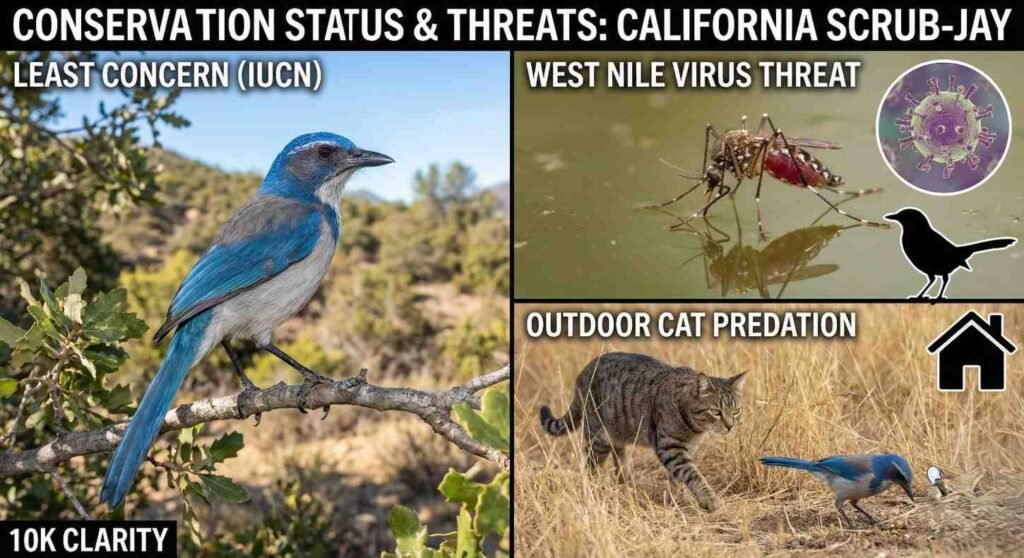
Currently, the California Scrub Jay is listed as a ‘Least Concern’ species by the IUCN. Their population is stable and even increasing in their northern ranges. However, they also face some specific local threats.
West Nile Virus
Corvids (which include jays and crows) are unusually susceptible to West Nile Virus, which is spread by mosquitoes.
When the virus first hit the West Coast in the early 2000s, scrub-jay populations in some areas declined dramatically. Although their numbers have now largely recovered, the virus remains a looming threat.
Outdoor Cats
Because scrub jays spend most of their time on the ground foraging for insects and burying acorns, they are at high risk of being preyed upon by domestic cats. Fledglings are particularly vulnerable. Keeping cats indoors is the single most effective way you can help protect local jay populations.