The Falcon Match: How to Choose the Perfect Bird of Prey for Falconry
Falconry is not just a hobby; it is a lifestyle, a discipline, and a living art that dates back more than 4,000 years. Unlike buying a dog or cat, you don’t simply “own” a bird of prey. You form a partnership with a wild predator—a relationship that is based entirely on trust and food, and…
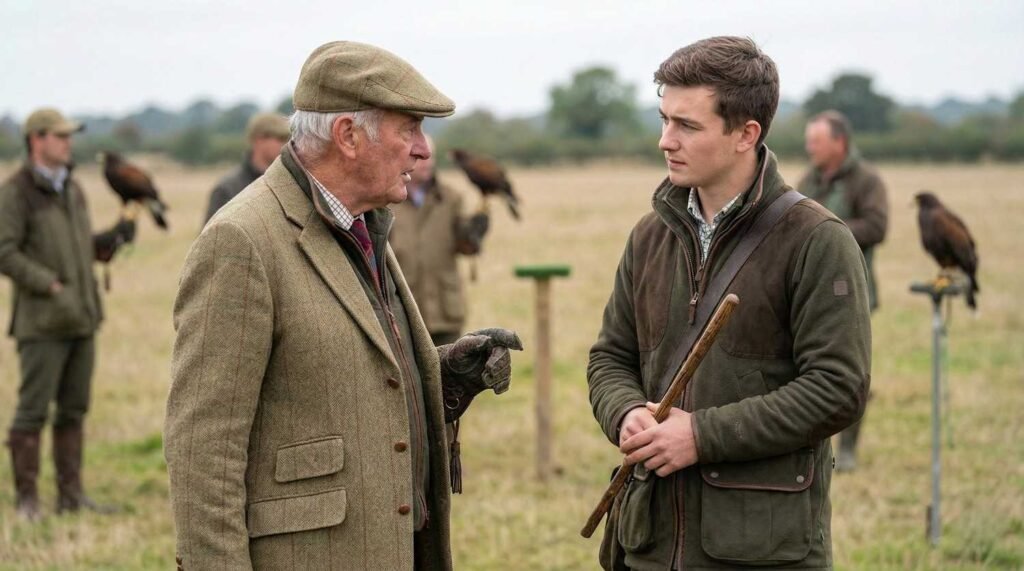
Falconry is not just a hobby; it is a lifestyle, a discipline, and a living art that dates back more than 4,000 years. Unlike buying a dog or cat, you don’t simply “own” a bird of prey. You form a partnership with a wild predator—a relationship that is based entirely on trust and food, and lacks the intimacy and attachment of a pet.
For a new falconer, the most important decision after taking up the sport is choosing the right falcon for you. This doesn’t mean choosing the bird that looks the most stunning on Instagram or the one that flies the fastest. In the world of hunting, “matching” a bird is a thoughtful equation that includes your local geography, the wild game available in your area, your level of experience, and your daily schedule.
Choosing the wrong bird results in frustration, lost birds, and unethical hunting practices. Choosing the right one results in that “divine madness” that hunters speak of—the perfect harmony of man and bird in pursuit of wild game.
The Golden Rule: Match the Bird to the Terrain
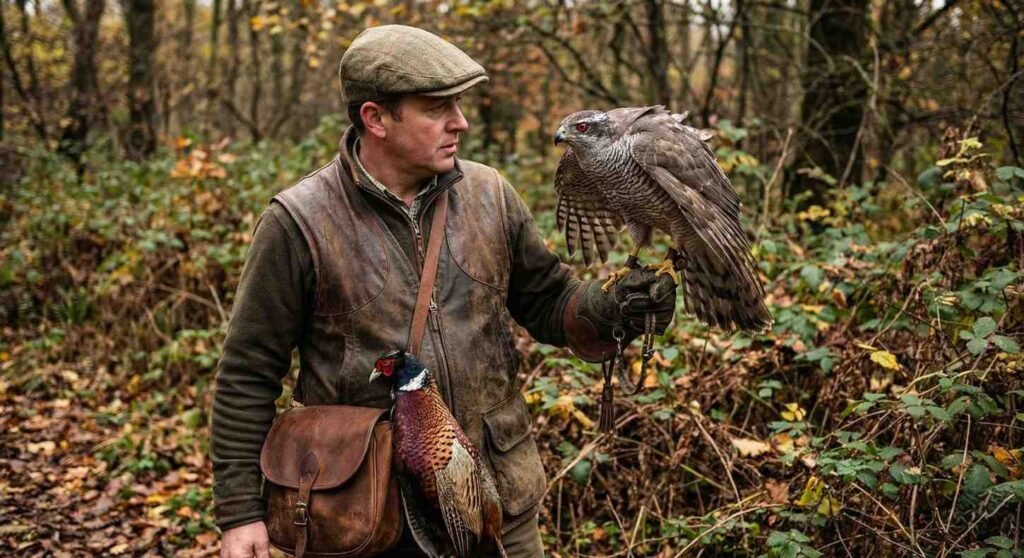
The single most common mistake beginners make is choosing a bird based on fantasy rather than geography. You might dream of flying a Peregrine Falcon because of its legendary 200 mph stoop. However, if you live in the dense woodlands of New England or the suburbs of London, a Peregrine is a catastrophic mismatch.
The “Longwing” Match (True Falcons)
True falcons (Peregrines, Gyres, Prairies, Merlins) are “Longwings.”3 They are evolved for the open sky.
- The Terrain Match: They require vast, open horizons—prairies, moors, or deserts. They hunt from high altitudes and need miles of space to stoop and recover.
- The Mismatch: If you fly a Peregrine in a wooded area, it will be frustrated by the trees, unable to gain the height it needs, and you will likely lose the bird as it chases prey over the horizon, out of sight.
The “Shortwing” Match (Accipiters)
This group includes the Northern Goshawk, Cooper’s Hawk, and Sharp-shinned Hawk.
- The Terrain Match: These are the forest phantoms. They are matched perfectly to dense woodlands, hedgerows, and tight spaces. They hunt by sprinting and maneuvering through trees.
- The Mismatch: While they can hunt in the open, they are nervous and high-strung. They are generally not a match for wide-open spaces where they feel exposed.
The “Broadwing” Match (Buteos)
This group includes the Red-tailed Hawk and Harris’s Hawk.4
- The Terrain Match: These are the SUVs of the falconry world. They are versatile, powerful, and adaptable. They can hunt from trees in the woods or from telephone poles in open fields.
- The Mismatch: They are slower than falcons. If your only available game is fast-flying birds (like ducks or pigeons), a Red-tail will struggle to catch them in a tail-chase.
The Apprentice’s Match: Where You Must Start
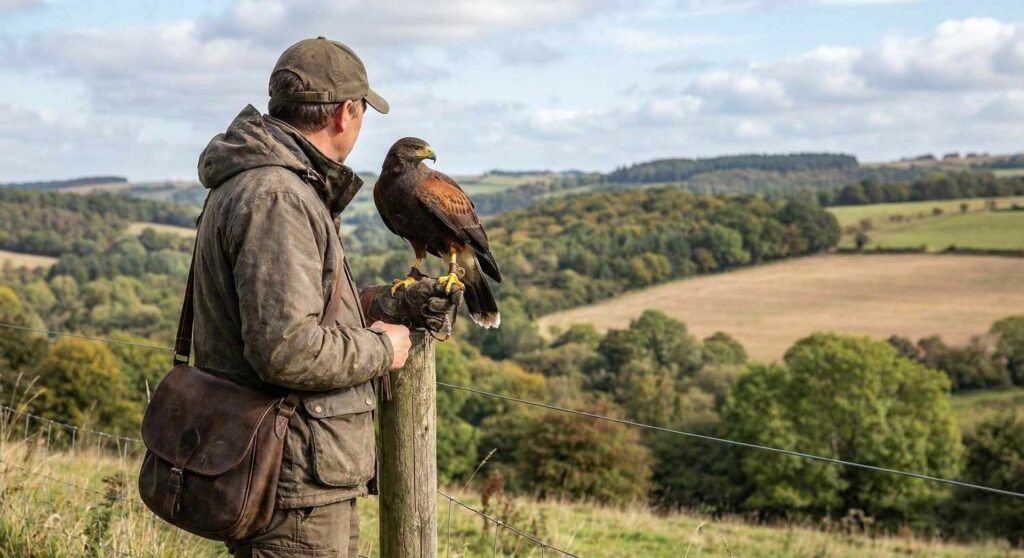
In the United States and many other nations with regulated falconry, you are not allowed to choose any bird you want. You must serve a two-year apprenticeship under a sponsor. During this time, your “match” is usually legally restricted to one of two birds.
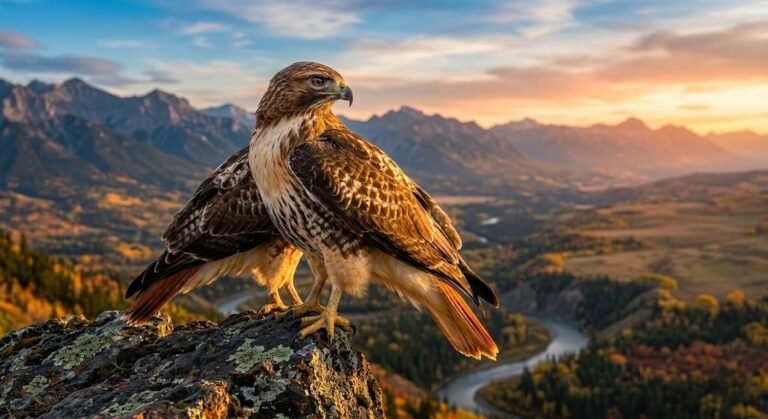
The Red-Tailed Hawk (The Absolute Standard)
For 90% of beginners, the Red-tailed Hawk is the ultimate match.
- Why it Fits: They are robust, hardy, and incredibly forgiving of mistakes. If you mess up their weight control slightly (a common beginner error), a Red-tail will likely survive and forgive you. A smaller falcon might die.
- The Hunt: They are ground-game hunters. If your area has squirrels and rabbits, the Red-tail is the king. They hunt off the fist or from a tree limb, crashing down with immense power.
- Temperament: They are generally calm and steady. Once manned (tamed), they are reliable and less prone to the neurotic panic attacks seen in Accipiters.
The American Kestrel (The Micro-Falcon)
The other common apprentice bird is the Kestrel, North America’s smallest falcon.5
- Why it Fits: They are tiny (the size of a soda can), meaning they require less space and food. They are a match for someone with limited land or who lives in a more suburban setting where large game isn’t available.
- The Hunt: They hunt starlings, sparrows, and mice. This is “micro-falconry.”
- The Warning: While allowed for beginners, they are actually difficult to manage. Because they are so small, their weight fluctuates rapidly. A Kestrel can starve to death in hours if you miscalculate their food. They are a “high-risk” match for a careless apprentice.
The Advanced Matches: Upgrading Your Partner
Once you have become a General or Master Falconer, the candy store opens. Now, you match the bird specifically to your passion.
The Harris’s Hawk (The Social Wolf)
Often called the “best bird in falconry,” the Harris’s Hawk is a unique match.
- The Profile: Unlike all other raptors, which are solitary, Harris’s Hawks hunt in family packs in the wild (the Sonoran Desert).6
- The Match: This is the perfect bird for the falconer who wants a “social” experience. You can fly them in groups (casts) with your friends. They are incredibly intelligent, easy to train, and have a dog-like personality.
- The downside: They are so smart they can learn bad habits quickly, like screaming for food or refusing to hunt if they think you will just feed them later.
The Northern Goshawk (The Potentate)
This is the “Ferrari” of the woods. It is a match only for the most dedicated, thick-skinned falconers.
- The Profile: The Goshawk is a pure predator. It is aggressive, high-energy, and possesses a “kill-switch” that is always on.
- The Match: If you are a serious hunter who wants to fill the freezer with pheasant, rabbit, and duck, and you are willing to tolerate a bird that might attack you in a fit of rage, the Goshawk is your match. They are not for the faint of heart.
The Peregrine Falcon (The Icon)
The bird of kings.
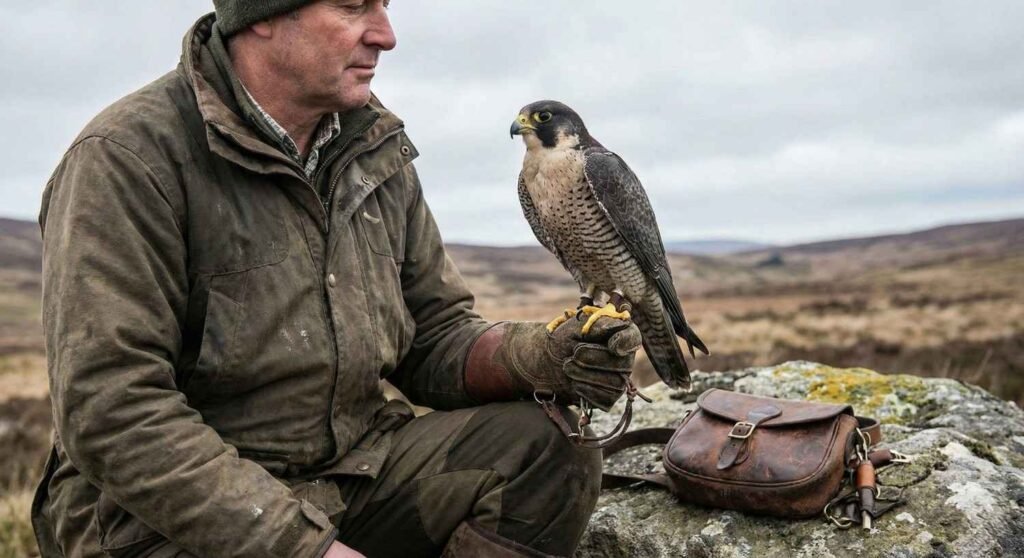
- The Match: You need patience. Training a Peregrine to “wait on” (circle high above your head) while you flush ducks requires months of dedicated training. This is a match for the falconer who enjoys the flight more than the kill. Watching a Peregrine stoop from 1,000 feet is a spiritual experience, even if they miss the target.
Matching the Game: What Lives in Your Backyard?
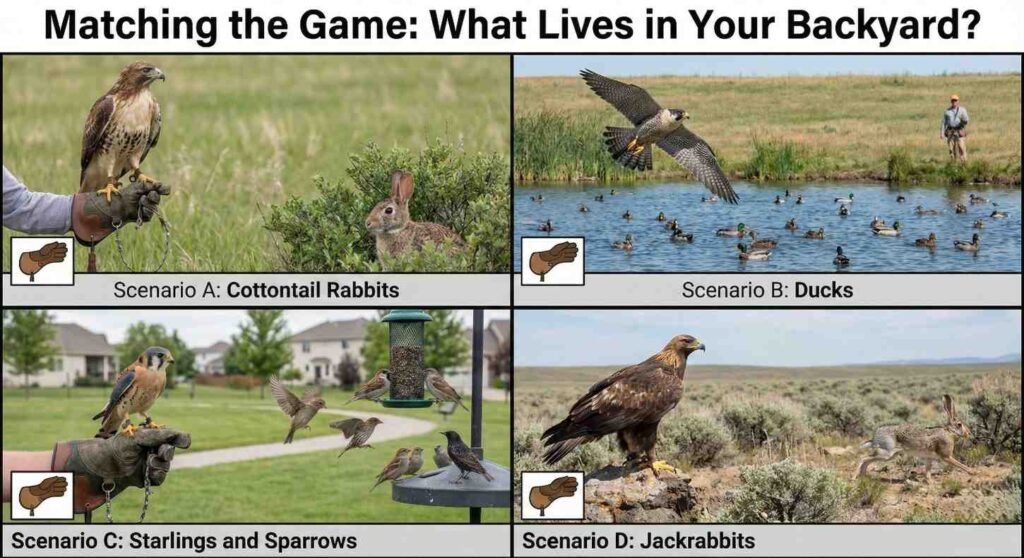
You cannot force a bird to hunt something it isn’t designed to catch. You must survey the wildlife in your immediate area before acquiring a bird.
- Scenario A: You have fields full of Cottontail Rabbits.
- The Match: Red-tailed Hawk or Harris’s Hawk.
- The Mismatch: Peregrine Falcon (Rabbits will just hide in a hole; the Falcon is an aerial hunter).
- Scenario B: You have ponds full of Ducks.
- The Match: Peregrine Falcon or Goshawk.
- The Mismatch: American Kestrel (Too small).
- Scenario C: You live in the suburbs with Starlings and Sparrows.
- The Match: American Kestrel, Merlin, or Sharp-shinned Hawk.
- The Mismatch: Red-tailed Hawk (Too big, too slow, and dangerous to fly near cars/houses).
- Scenario D: You have vast open sagebrush with Jackrabbits.
- The Match: Golden Eagle or a large female Red-tail/Harris.
- The Mismatch: Cooper’s Hawk (A Jackrabbit is strong enough to injure or kill a small hawk).
The Lifestyle Match: Time and Money
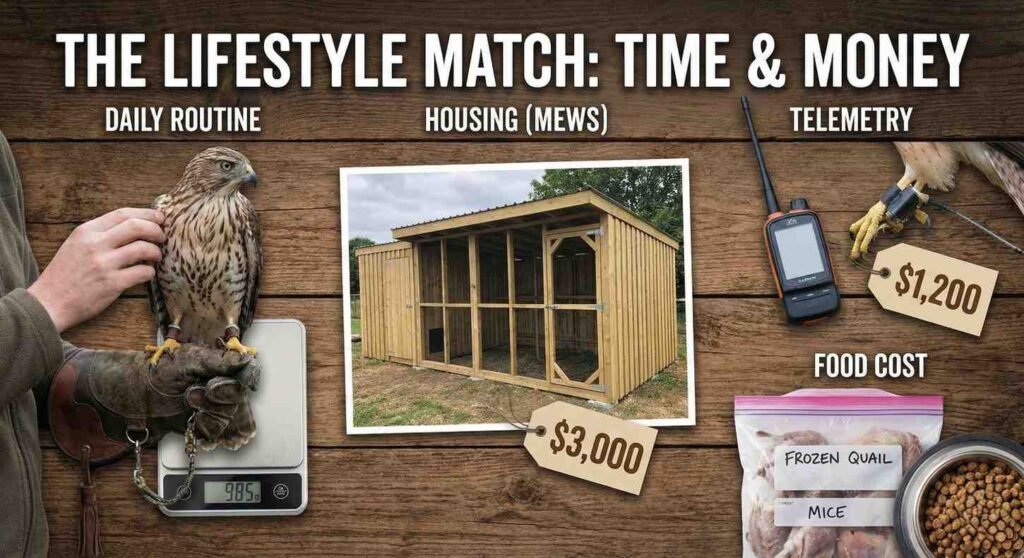
Raptors are not like rifles that you can clean and put in a safe until hunting season. They are metabolic engines that require daily tuning.
Time Commitment
- Daily Routine: You must weigh your bird every single day to the gram. You must prepare fresh meat (quail, mice, chicks). You must “man” the bird (spend time with it on your fist) to keep it tame.
- Hunting: During the season (fall/winter), you need to hunt at least 3-4 times a week. If you work a job that requires travel or 60-hour weeks, falconry is not a match for you. The bird will become “cage sour” (mentally ill) if left sitting in a mews (enclosure) all day.
The Budget Match
- Housing (Mews): You cannot keep a falcon in a birdcage. You must build a “Mews”—a specialized outdoor weathering yard and indoor shelter. This must pass a government inspection. Cost: $1,000 – $5,000.
- Telemetry: If you fly a falcon, you need a GPS tracker or radio telemetry to find it when it flies 5 miles away. Cost: $1,000+.
- Food: You cannot feed them hamburger meat from the grocery store. They need whole prey (bone, fur, feather). You will be buying frozen quail and mice in bulk. Cost: $2-3 per day.