The Ultimate Guide to the Kangaroo Diet: What Do These Marsupials Eat?
When you imagine a kangaroo diet, you probably picture a powerful animal bounding across the red dirt of the Australian outback. Those big, strong hind legs require a tremendous amount of energy to propel them. But what exactly powers these iconic marsupials?convert into the Urdu If you’re a wildlife enthusiast in the United States or…
When you imagine a kangaroo diet, you probably picture a powerful animal bounding across the red dirt of the Australian outback. Those big, strong hind legs require a tremendous amount of energy to propel them. But what exactly powers these iconic marsupials?
convert into the Urdu If you’re a wildlife enthusiast in the United States or the United Kingdom, the inner workings of Australia’s ecosystem may seem like a whole different world to you. You might be surprised to learn that a kangaroo’s diet is highly specialized, incredibly efficient, and perfectly adapted to some of the harshest environments on the planet.
Whether you’re planning a trip to Australia, doing research for a school project, or just satisfying your curiosity, let’s dive into this fascinating fact about what kangaroos eat, how they digest it, and why you should never give them a piece of bread.
Are Kangaroos Herbivores? Basics of Their Diet
To put it simply: Yes, kangaroos are completely herbivorous. Instead, the basis of a kangaroo’s diet is entirely plant-based.
They play the same ecological role in Australia as deer, elk and wild boar do in North America and Europe. They spend most of their waking hours foraging and grazing. Since Australia can be very hot during the day, kangaroos are most active at dawn, dusk and at night. This means that they eat most of their food at dawn, dusk and at night.
However, it is a common misconception that all kangaroos eat exactly the same things. Just as a moose eats a different diet than a white-tailed deer, a kangaroo’s specific diet depends entirely on its species and its habitat.
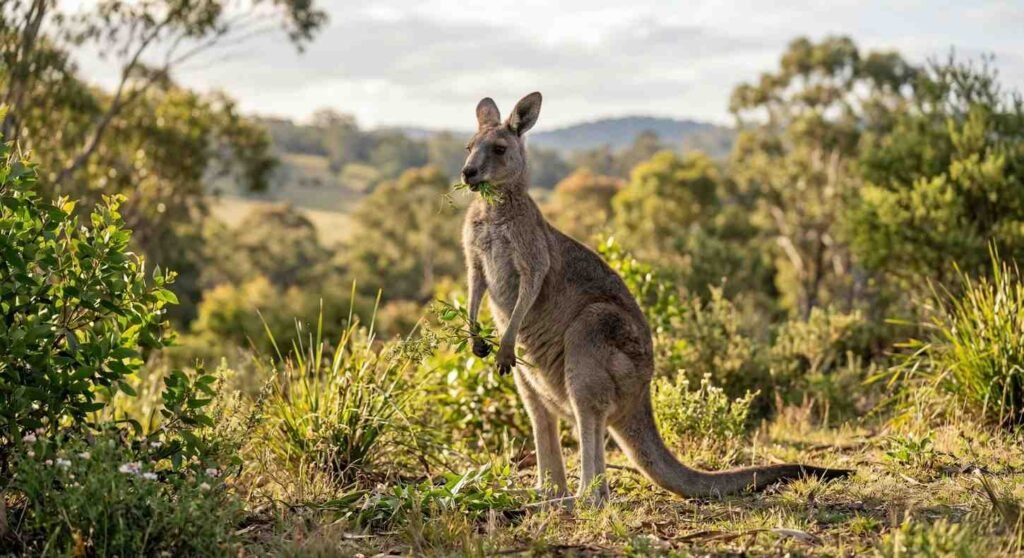
The Kangaroo Diet by Species: Not All Menus Are Equal
Australia is home to four main species of “true” kangaroos, alongside dozens of smaller macropods like wallabies and pademelons. Here is a breakdown of what the four largest kangaroo species eat in the wild.
1. The Red Kangaroo (Osphranter rufus)
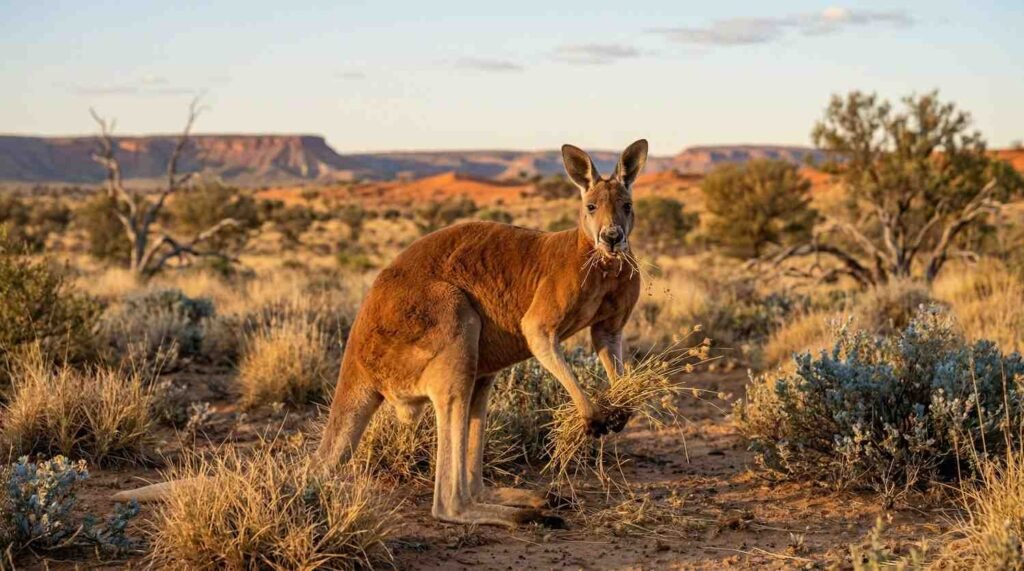
The Red Kangaroo is the largest marsupial on earth, and it lives in the punishing, arid deserts of central Australia. Their diet is mostly made up of fresh grasses and forbs (flowering plants). Remarkably, even when the landscape looks entirely brown and dead to human eyes, Red Kangaroos have a knack for finding the tiny green shoots of grass surviving near the soil. When grass is scarce, they will adapt by eating the leaves of desert shrubs.
2. The Eastern Grey Kangaroo (Macropus giganteus)
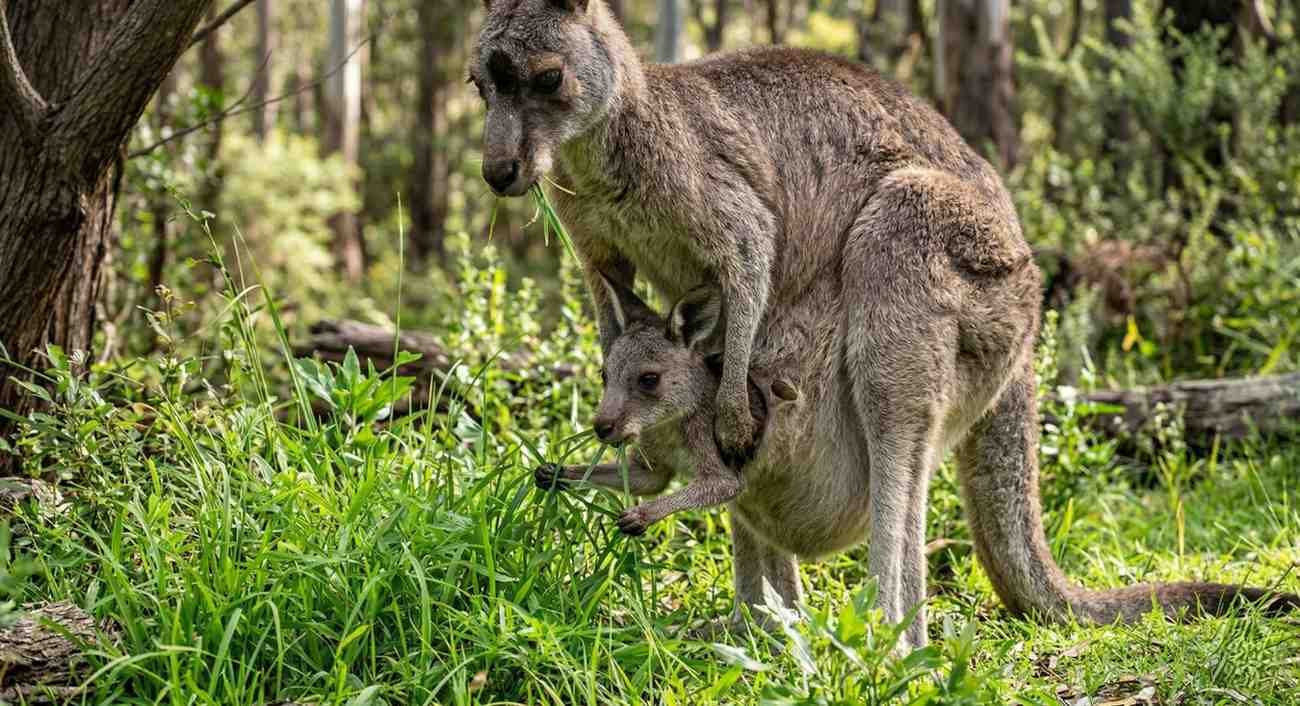
If you see a picture of a kangaroo on a lush golf course or a coastal reserve, it is likely an Eastern Grey. Because they live in the more fertile, wooded areas of eastern Australia, their diet is quite rich. They heavily prefer young, green woodland grasses. However, they are also known to forage for fungi, moss, and low-hanging leaves in the forest understory.
![[Image: Eastern grey kangaroo eating lush green grass in woodland.]](https://falconrynews.com/wp-content/uploads/2026/03/2-5-1024x558.jpeg "The Ultimate Guide to the Kangaroo Diet: What Do These Marsupials Eat?")
3. The Western Grey Kangaroo (Macropus fuliginosus)
Found across the southern and western coasts of the continent, the Western Grey Kangaroo has an incredibly tough digestive system. While they love coarse grasses, their habitat features a lot of tough, woody vegetation. They will readily eat shrubs, herbs, and even tree bark. Fascinatingly, the Western Grey has evolved to safely consume certain native plants that are highly toxic to other grazing animals and livestock!
4. The Antilopine Kangaroo (Osphranter antilopinus)
Living in the tropical, monsoonal savannas of northern Australia, the Antilopine Kangaroo experiences extreme wet and dry seasons. They are almost exclusively grass-eaters. They prefer short grasses and will often flock to areas recently burned by wildfires to feast on the highly nutritious new shoots that emerge from the ashes.
What About Tree Kangaroos?
It is worth noting that not all kangaroos live on the ground. Tree kangaroos live in the rainforest canopies of Queensland and New Guinea. Because of their arboreal lifestyle, their diet is vastly different. They eat leaves, ferns, nuts, and fruit. Some tree kangaroos will even exhibit omnivorous behavior, occasionally eating bird eggs or small insects, making them the major exception to the strict herbivore rule.
![[Image: Cute tree kangaroo chewing on a green leafy branch.]](https://falconrynews.com/wp-content/uploads/2026/03/4-4-1024x558.jpeg "The Ultimate Guide to the Kangaroo Diet: What Do These Marsupials Eat?")
The Marvel of Kangaroo Digestion: Chewing the Cud
The most fascinating aspect of the kangaroo diet isn’t just what they eat, but how their bodies process it.
Grasses and shrubs are highly fibrous and notoriously difficult to digest. While cows and sheep solve this problem by having stomachs with four separate chambers, kangaroos have a single-chambered stomach. However, their stomach is uniquely structured with a specialized tubiform region that acts like a fermentation vat.
Inside this vat, millions of specialized bacteria and fungi break down the tough plant cellulose. Similar to cows, kangaroos will occasionally regurgitate their food (bringing it back up into their mouths) to chew it again. This process of “chewing the cud” further breaks down the plant fibers, ensuring the kangaroo extracts every possible drop of nutrition and moisture from their meager meals.
A Dental Miracle: The Marching Molars
Grass is incredibly abrasive. It contains microscopic silica crystals that act like sandpaper, wearing down the teeth of grazing animals over time. If a kangaroo lost its teeth, it would starve. Nature solved this problem with a brilliant evolutionary trait.
A kangaroo has sharp front incisors designed to snip grass tightly against the ground. In the back of their mouth, they have flat molars for grinding. As the front molars are worn down to the gums by the rough diet, they naturally fall out. Then, the teeth behind them literally shift forward in the jaw to take their place, while brand-new teeth grow in the back! This rare process, called polyphyodonty, ensures they always have sharp teeth to process their food.
How Do Kangaroos Survive Without Water?
Of all the continents inhabited by human settlements, Australia has the unique distinction of being the driest due to its arid lands.Surface water can vanish for months or even years during severe droughts. So, how does the kangaroo diet support their hydration?
Red Kangaroos, in particular, are masters of water conservation. They rarely need to drink liquid water from a stream or a puddle. Instead, they extract almost all the moisture they need directly from the plants they eat.While foraging in the cool of the night, these animals get additional water from dew on plants, which serves as a natural source of quenching their thirst.
Furthermore, a kangaroo’s kidneys are highly specialized to concentrate their urine, minimizing water loss. During periods of extreme drought, they will limit their physical activity to save energy and moisture until the rains return.
What Do Baby Kangaroos (Joeys) Eat?
A kangaroo’s diet changes drastically over its lifespan. When a baby kangaroo, called a joey, is born, it is the size of a jellybean. It immediately crawls into its mother’s pouch, where it attaches to a teat.
For the first six months of its life, the joey’s diet is 100% mother’s milk. The mother’s body is actually capable of producing two different types of milk simultaneously if she has a newborn in the pouch and an older joey grazing outside! Once the joey is about six to eight months old, it will start popping its head out of the pouch to nibble on nearby grasses, slowly transitioning to a solid herbivore diet before leaving the pouch entirely.
Captive Kangaroos: What Do Zoos Feed Them?
If you visit a zoo or wildlife sanctuary in the US or UK, the kangaroos there eat a slightly different diet than their wild cousins.
Because zookeepers cannot replicate the vast, sprawling Australian bush, they feed captive kangaroos a highly controlled, nutritionally balanced diet. This usually includes:
- High-Fiber Pellets: Specially formulated herbivore pellets that mimic the nutritional profile of native grasses.
- Hay and Alfalfa: Provided constantly to keep their digestive tracts moving and their teeth worn down safely.
- Fresh Vegetables: Carrots, broccoli, and leafy greens are offered as healthy supplements.
- Fruit: Apples and bananas are occasionally given as high-value training treats, though they are kept to a minimum due to their high sugar content.
Why You Should Never Feed Wild Kangaroos
If you are ever lucky enough to travel to Australia and encounter wild kangaroos, you might be tempted to offer them a snack. Do not do this. Human food is incredibly dangerous for kangaroos. Bread, chips, and processed foods contain complex carbohydrates and sugars that their digestive bacteria cannot process. Feeding them these items can cause a fatal condition known as “Lumpy Jaw,” a severe bacterial infection in the bone that prevents the animal from eating, leading to starvation.
Furthermore, feeding wild kangaroos habituates them to humans. This makes them aggressive and demanding, which often results in the animals being labeled a “nuisance” and relocated or culled by wildlife authorities. If you want to respect the kangaroo diet, the best thing you can do is observe them grazing naturally from a safe distance.
Conclusion
The kangaroo diet is a testament to the resilience of nature. These magnificent animals have evolved to thrive on tough, abrasive grasses, survive on minimal water, and extract nutrients in ways that baffle modern science. From their continuously replacing teeth to their highly efficient stomachs, every inch of a kangaroo is built to make the most out of the harsh Australian landscape.
The next time you see a video of a kangaroo bounding effortlessly across the plains, you will know exactly what fuels that incredible journey: a lot of grass, a highly adapted stomach, and millions of years of evolutionary perfection.